BRACE: Batch Route Analysis for Cost-Efficient Synthesis
Koziarski Lab · The Hospital for Sick Children (SickKids), Toronto
The problem. A generative model can design thousands of candidate drug molecules. A wet lab can afford to synthesize a few hundred. Ranking by predicted quality and taking the top N ignores that every candidate needs its own reactions, reagents and bench time. Two molecules that share four of their five synthesis steps cost far less together than two unrelated molecules of equal predicted quality.
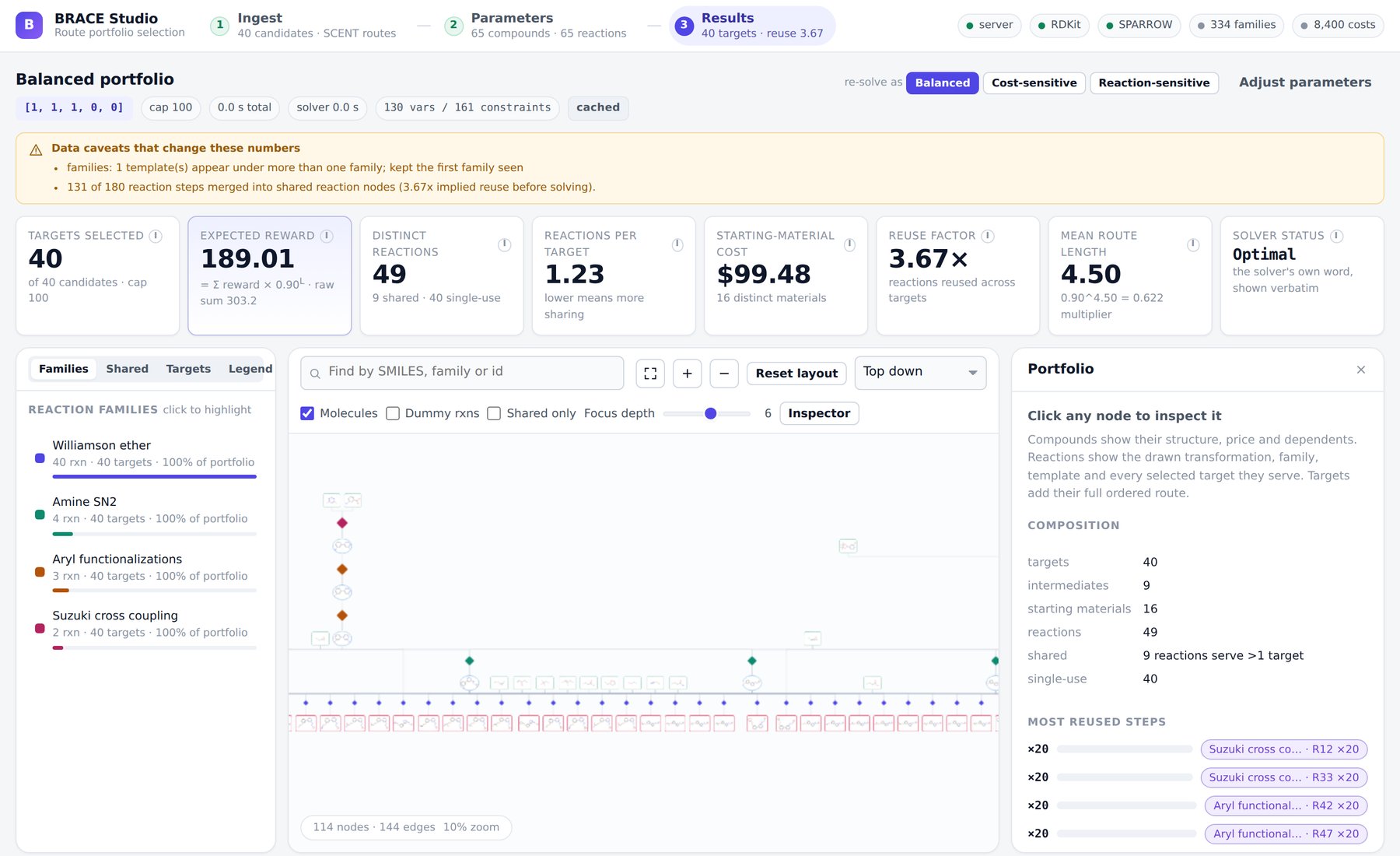
What BRACE does. It pairs a generative model that emits each molecule together with its synthesis route (SCENT, a reaction-template GFlowNet, and its late-stage variant SCENT-LSD) with an optimizer that charges a shared reaction only once (SPARROW). The research question is a fixed-budget comparison between two sampling strategies: does re-sampling only the last step of a proven route give a better synthesis portfolio than simply drawing more molecules?
- My part
- The pipeline that combines the pieces into something chemists can use to pick what to make, and the entire evaluation. SCENT, SCENT-LSD and SPARROW existed before this work.
Checked my own numbers
Before circulating draft 2 I re-derived every headline figure in draft 1 and corrected six of them. The largest: a reward ratio against the ASKCOS planner computed with two different averaging methods on the two sides of the comparison. One consistent estimator over the 192 shared targets took it from 3.06× to 2.15×. All six corrections are written into the draft's change log.
- SCENT
- A reaction-template GFlowNet. Emits each molecule with the route used to build it.
- SCENT-LSD
- Keeps a route's prefix and re-samples only the final reaction, so analogues share their upstream chemistry.
- SPARROW
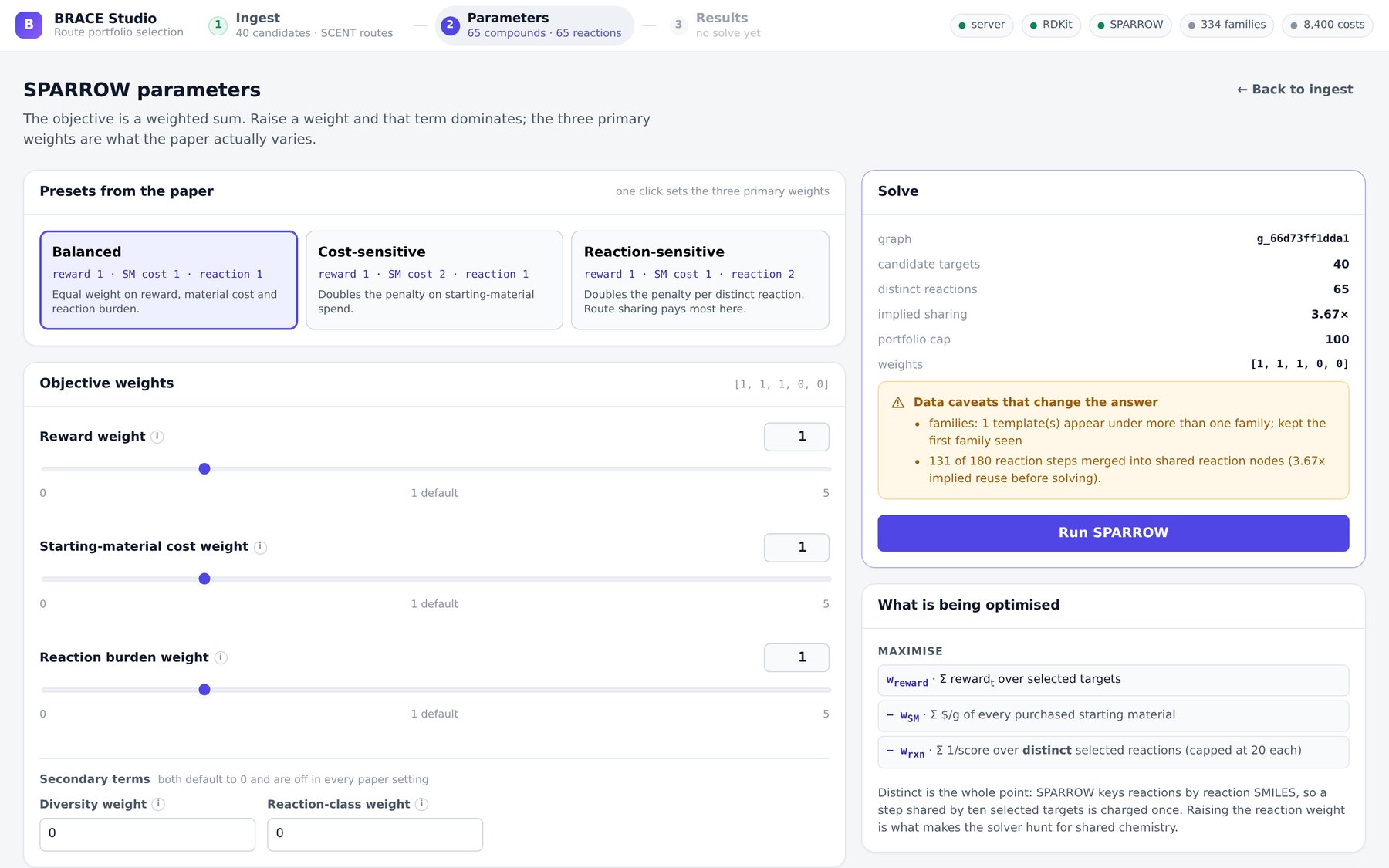
- Route-and-selection optimizer. Keys reactions by reaction SMILES, so a shared step is charged once.
- ASKCOS
- MIT's retrosynthesis planner, self-hosted here. Plans routes to the same targets as the independent control.